
Managing high volumes of customer messages on WhatsApp creates structural response latency that degrades customer experience and conversion probability. Because WhatsApp functions as a real-time conversational channel, users expect immediate, context-aware responses. Any delay or incorrect automation breaks trust instantly.
Businesses attempt to fix this with basic automation, but poorly designed flows easily frustrate users. Integrating a well-configured Steps AI Chatbot directly into your WhatsApp strategy solves this by handling routine inquiries accurately while knowing exactly when to escalate. This guide outlines the most effective WhatsApp chatbot use cases, what typically goes wrong in deployment, and how to evaluate the right approach for your team.
Managing High-Volume Customer Inquiries
Handling repetitive questions about business hours, policies, and account status drains resources from your support team. Automating these specific touchpoints is critical for scaling operations without expanding headcount.
Many businesses fail here by deploying bots that do not understand natural language variations. Customers get trapped in repetitive loops asking the same question and receiving irrelevant answers. When implemented poorly, you quickly see instances of when chatbots hurt customer experience by acting as a barrier rather than a helpful tool.
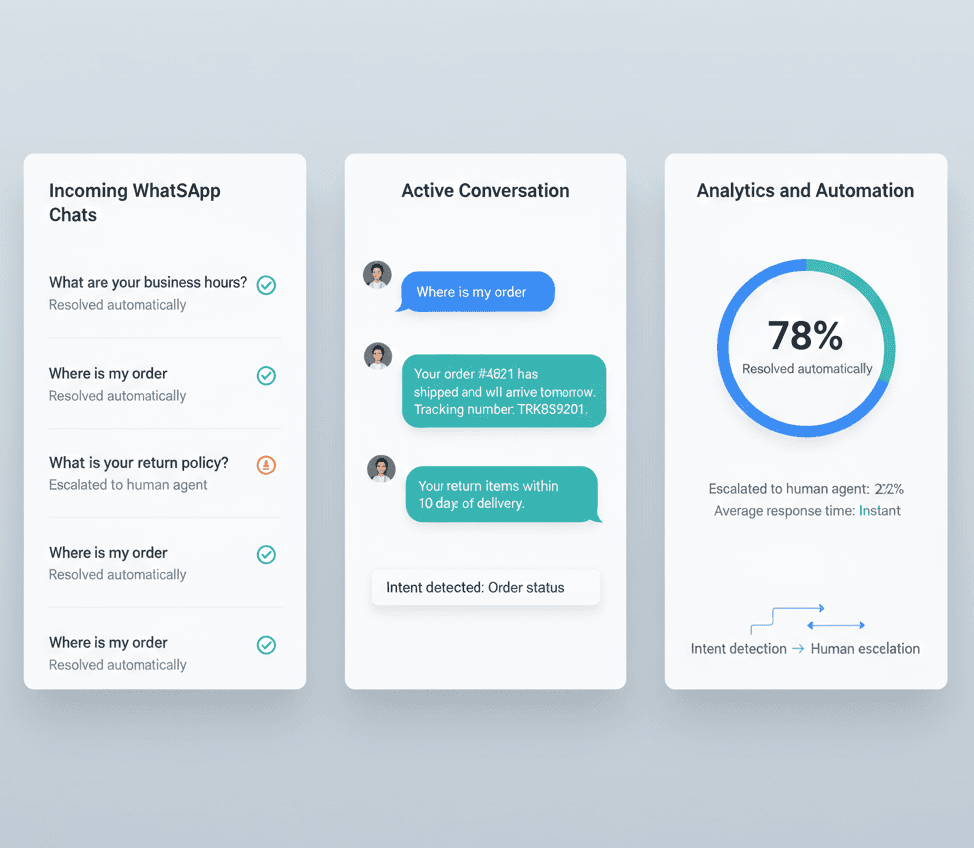
A proper implementation uses natural language processing to accurately answer visitor questions in real-time. A good system instantly resolves common queries like order tracking or return policies, freeing human agents to handle complex issues. Using the Steps AI Chatbot ensures your automation handles these high-volume tasks reliably without sacrificing response quality.
Driving Conversational Commerce and Sales
WhatsApp is a highly personal channel where buyers expect rapid engagement. Capturing intent the moment a customer shows interest is vital for converting a casual inquiry into a completed sale.
The biggest mistake companies make in conversational sales is being overly promotional. Blasting broad catalogs to users or failing to qualify leads properly feels intrusive and leads to immediate blocks or opt-outs. Bots that cannot answer specific product questions actively kill the buying momentum.
A successful sales chatbot acts as a guided shopping assistant. It asks qualifying questions to narrow down preferences and provides highly relevant product recommendations. It can also send timely abandoned cart reminders or restock notifications that actually provide value to the buyer, ultimately helping ecommerce websites convert better.
Streamlining Triage and Human Handoff
Not every problem can be solved by automation. Knowing exactly how and when to route a customer to a human agent is what separates a frustrating system from an efficient one.
Many chatbot implementations fail because they attempt to force an automated resolution for highly complex or sensitive issues. Systems that lack a seamless routing protocol create massive bottlenecks in your support queue. Understanding the role of a conversational interface layer is essential here.
A highly effective setup collects necessary context before seamlessly transferring the conversation history to the right department. This transforms the chatbot from a static responder into an intelligent routing layer. This strategy is essential for reducing support tickets with chatbots because the agent receives all the required information instantly and can resolve the escalated issue much faster.
Common WhatsApp Chatbot Implementation Failures
Many WhatsApp chatbot deployments fail because they operate without direct integration into backend systems like CRMs, order databases, or support platforms. When the chatbot cannot access real-time customer or order data, it provides generic, "canned" responses that frustrate users rather than resolving their actual issues.
Another major failure is forcing rigid scripted flows that do not adapt to natural user language. WhatsApp users expect a fluid, conversational interaction—not a clunky, menu-driven navigation experience. Bots that cannot interpret intent accurately or handle "off-script" questions cause users to abandon the conversation entirely, often leading to brand distrust.
Effective WhatsApp chatbot deployment requires treating the chatbot as a real-time operational interface connected to your business systems, not just an isolated automation script layered on top of messaging. Without this system-wide connectivity, the bot remains a hurdle rather than a help.
Conclusion
Evaluating WhatsApp automation requires a clear understanding of your specific operational bottlenecks. You must avoid deploying rigid systems that trap customers in dead ends. A balanced system handles repetitive support tasks flawlessly while improving overall engagement. Choosing a reliable foundation like Steps AI Chatbot ensures you mitigate implementation risks while actively improving the customer experience. In WhatsApp environments, the chatbot becomes the real-time interface between customer intent and your operational systems.
Try Steps AI Chatbot to see how it works.
FAQs
What is the best use case for a WhatsApp chatbot?
The most effective use case is automating high-volume routine support inquiries—such as order tracking, FAQ resolution, and account status checks. This allows businesses to provide instant gratification to users while freeing up human agents for high-value tasks.
Can a WhatsApp chatbot actually generate sales?
Yes. By using conversational commerce strategies, a chatbot can qualify leads through targeted questions, offer personalized product recommendations, and send automated abandoned cart reminders to recover lost revenue.
Will a chatbot replace my customer support team?
No. A chatbot is designed to act as an intelligent triage layer. It handles repetitive queries and collects user context, then ensures a seamless human handoff for complex or sensitive issues that require empathy and critical thinking.
Why do most WhatsApp chatbots fail?
Failure usually stems from a lack of backend integration. If a bot cannot communicate with your CRM or database, it cannot provide personalized answers. Furthermore, rigid, menu-based flows often frustrate users who expect a natural language experience.
How does a chatbot reduce support ticket volume?
By providing instant self-service options for common problems, a chatbot resolves issues at the source. When a bot handles 80% of repetitive questions, the total number of tickets reaching your human support queue drops significantly, improving operational efficiency.