
Businesses managing customer interactions through WhatsApp eventually encounter a strict operational ceiling. When message volume scales beyond a few dozen inquiries per day, the reliance on human operators creates a structural bottleneck that compromises both revenue and customer satisfaction. Manual handling introduces severe response delays, resulting in lost leads and a fragmented customer experience that damages brand perception. Operators find themselves constantly switching contexts between simple questions and complex problem solving, leading to inevitable errors and operational exhaustion.
To resolve this structural flaw, organizations require an intelligent infrastructure layer capable of managing conversations autonomously before human intervention is required. Implementing Steps AI Chatbot functions as this critical automation and routing layer. By processing incoming messages instantly, this system ensures that operational workflows remain uninterrupted regardless of peak traffic hours or sudden spikes in message volume. The technology acts as a conversational gateway, evaluating every inbound request and executing predefined business logic to handle the inquiry appropriately.
Throughout this operational guide, we will analyze the exact mechanics of how WhatsApp chatbots automatically respond to messages, classify user intent, and route conversations directly to the correct internal systems. We will explore the technical realities of replacing manual bottlenecks with a scalable conversational infrastructure capable of driving modern business growth. We will also detail how these systems integrate with your existing technology stack to create a seamless operational environment.
Why Manual WhatsApp Management Breaks at Scale
The fundamental problem with manual WhatsApp management is that human bandwidth scales linearly while message volume scales exponentially. When a marketing campaign succeeds or a product goes viral, customer inquiries flood the system faster than any team can reasonably process them. This message volume growth creates immediate response bottlenecks. Human agents are simply incapable of reading, processing, and typing responses to hundreds of concurrent messages without severe latency. The mathematical reality of manual operations dictates that as volume increases, response times lengthen, causing severe degradation in service quality.
Because human agents are bogged down by these routine inquiries, high-intent prospects who are ready to make a purchase are forced to wait in the exact same queue as existing customers asking for simple status updates. This waiting period is actively detrimental to business outcomes. A delay of even a few minutes in a conversational channel like WhatsApp often results in lost sales due to delayed replies. The prospect abandons the interaction entirely and moves on to a competitor who can provide immediate gratification. In a digital ecosystem where speed-to-lead is a primary driver of conversion, relying on manual responses creates a leaky sales funnel.
This dynamic inevitably leads to massive operational overload. Operators find themselves overwhelmed by repetitive questions regarding order tracking, basic pricing, and standard business hours. Support and sales teams suffer from burnout trying to manage the expanding message backlog, which severely degrades their ability to handle nuanced, high-value conversations. Human operators are exceptionally valuable for resolving complex customer issues and closing deals, but their utility is wasted when they are deployed as the first line of defense for every incoming text message. The structural limitations of human-only handling guarantee failure at scale. Modern operations require a system that acts as an initial filter to protect human capital from operational exhaustion.
How WhatsApp Chatbots Automatically Respond to Messages
Understanding how automated systems process inbound text requires looking past generic software concepts and focusing on the underlying operational mechanics. When a user sends a message, an advanced chatbot immediately processes the text to perform strict intent detection. This means the system analyzes the semantics of the message to understand what the user is actually trying to accomplish, rather than simply looking for rigid keyword matches. This nuanced capability sets modern implementations apart when evaluating an AI chatbot for website vs traditional chatbots or standard WhatsApp auto-responders that fail when a user spells a word incorrectly.
Once the intent is securely identified, the system formulates a contextual reply based on real-time data. If a user asks about an order status, the chatbot does not simply provide a generic link. Instead, it communicates via API with the integrated e-commerce database, retrieves the exact shipping tracking information, and responds instantly within the WhatsApp chat thread. This process requires robust operational connectivity, allowing the chatbot to read and write data across different software environments securely and efficiently.
For lead capture automation, the chatbot recognizes buying intent and dynamically asks a structured series of qualifying questions. It gathers the prospect's contact information, budget, and specific requirements systematically, populating the company CRM in the background. Furthermore, FAQ automation is handled seamlessly by pulling from a structured knowledge base to deliver precise answers to routine queries regarding return policies or service areas. The responses generated are entirely dependent on the operational data and system integrations connected to the chatbot, ensuring that the customer receives accurate information without requiring any human oversight.
How WhatsApp Chatbots Connect to WhatsApp Business API and Internal Systems
To function as a true message processing layer, a chatbot must sit between the user-facing WhatsApp application and the company's internal software stack. This connection is facilitated through the WhatsApp Business API. The process begins when a user sends a message; this action triggers a webhook event on the WhatsApp server. This webhook sends a detailed message payload containing the text content, sender's phone number, and timestamp directly to the chatbot's processing engine.
Maintaining this infrastructure requires adherence to the WhatsApp 24-hour messaging window. When a user sends a message, a business has a 24-hour period to respond with free-form content. If the window closes, the business can only re-initiate contact using pre-approved template messages. Steps AI Chatbot manages these constraints automatically by monitoring the session status and triggering the appropriate template message if a follow-up is required after the window has lapsed. This ensures that the operational flow remains compliant with Meta’s policies while preventing communication drop-offs.
The full infrastructure pipeline functions as follows:
The user sends a WhatsApp message: The interaction begins on the user's mobile device.
WhatsApp Business API receives message: The API acts as the official gateway for enterprise messaging.
Webhook sends payload to chatbot: The API transmits the raw data to Steps AI Chatbot, which serves as the conversational intake and intent classification engine.
Chatbot detects intent: The processing layer analyzes the payload to determine if the user is seeking support, making a purchase, or asking a general question.
Chatbot executes automation or routing logic: Based on the intent, the system decides whether to answer immediately or hand the chat to a specialist.
Chatbot sends data to CRM or support system: Relevant data (like lead details or ticket info) is pushed to the backend (e.g., Salesforce, HubSpot, or Zendesk).
Chatbot sends a reply back via WhatsApp API: The final response is delivered back to the user's WhatsApp thread.
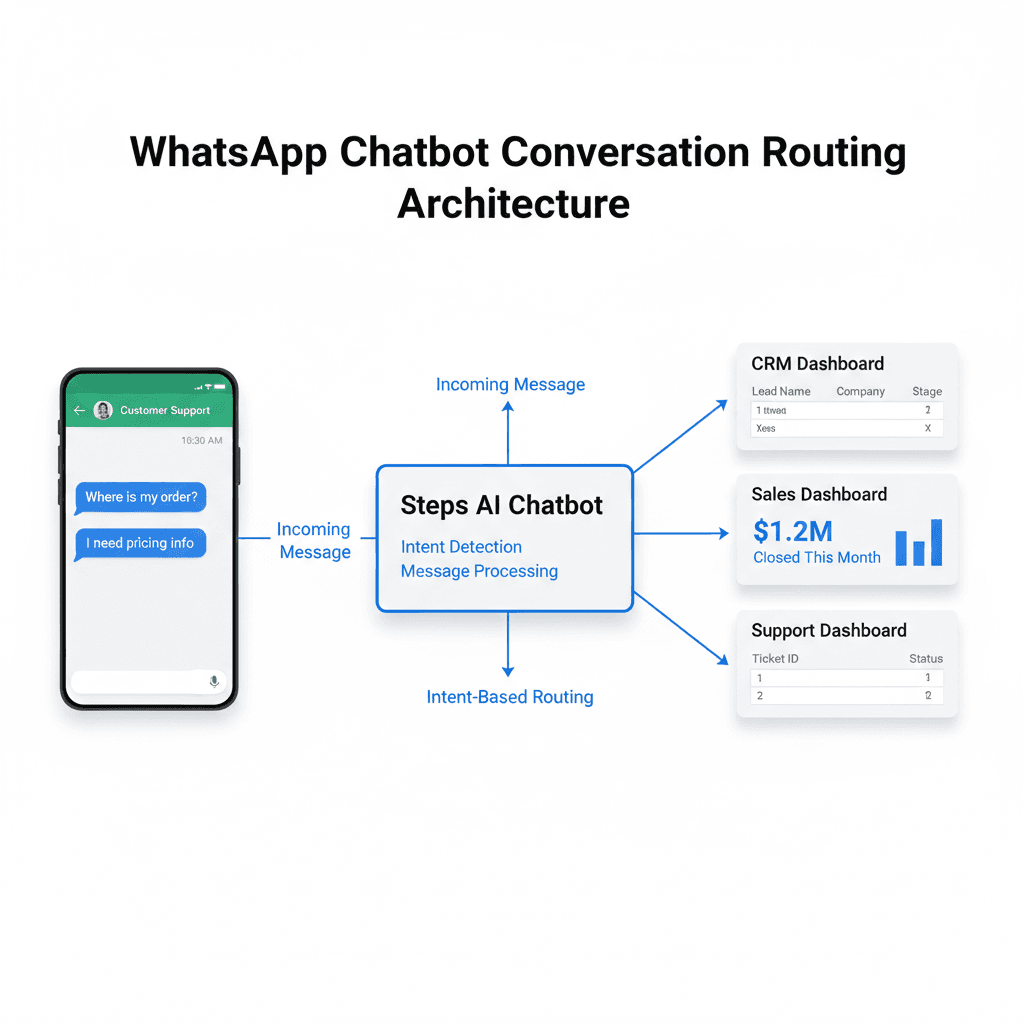
From a systems perspective, this architecture converts WhatsApp from a simple messaging channel into a structured operational pipeline. Each incoming message is captured by the WhatsApp Business API, transmitted via webhook to Steps AI Chatbot for processing, classified according to business intent, and routed to the appropriate backend system. The chatbot then executes the required logic and delivers a response back through the WhatsApp transport layer. Because webhook delivery and intent classification occur asynchronously on server infrastructure, this entire routing and response cycle typically completes in under a few seconds, even during high message volume periods.
How Chatbots Route Conversations to the Right Team or Workflow
Beyond simple automated replies, the true value of conversational infrastructure lies in its ability to direct traffic efficiently. A WhatsApp chatbot operates as a highly specialized triage unit, assessing every incoming conversation and routing it to the appropriate destination based on predefined business logic. This routing mechanism functions as a comprehensive conversational interface layer that sits between the customer and the internal operations of a company. It ensures that the digital pathways within a business remain organized and logical.
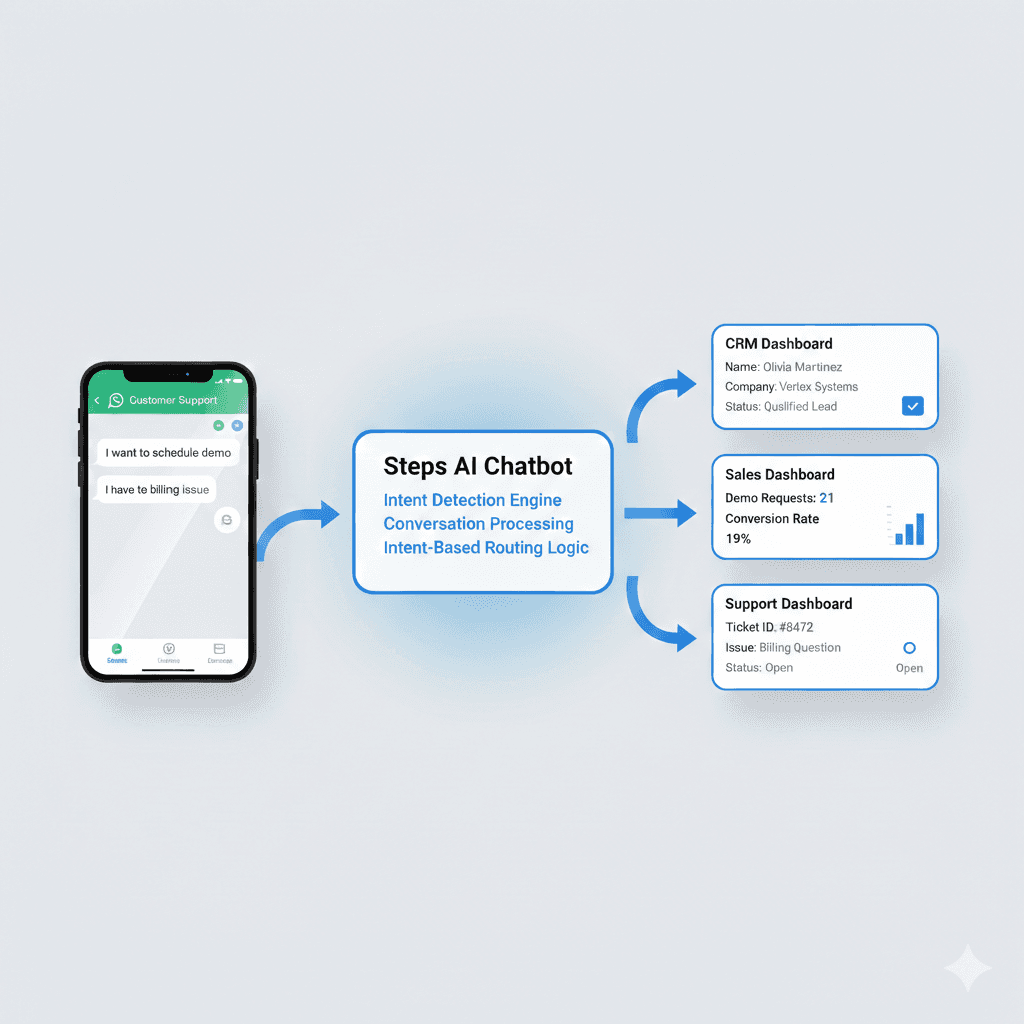
The full operational pipeline follows a strict sequence: a raw WhatsApp message is received and sent via webhook to the chatbot intake layer, where it undergoes intent classification. Once the category is identified, the routing logic directs the data to the appropriate CRM or helpdesk system. Finally, a response is formulated and sent back through the API to the user. This systematic process ensures that every interaction from the initial "Hello" to the final resolution is logged and handled by the correct resource, whether that is an automated response or a human specialist.
For example, in an ecommerce environment, when a customer asks “Where is my order,” Steps AI Chatbot retrieves the order data from the backend system, identifies the shipping carrier and tracking status, and responds instantly within WhatsApp. If the customer reports a delivery issue, the system automatically classifies the interaction as a support escalation and routes it to the fulfillment or support team with the full conversation context attached.
When a user expresses buying intent or asks for a product demonstration, the system triggers specific sales routing protocols via Steps AI Chatbot. It transfers the chat history, along with the captured lead qualification data, directly to an available sales representative's dashboard. Conversely, if a user describes a technical problem, reports a bug, or disputes a billing error, the system initiates support routing. This workflow sends the categorized ticket directly to the customer success team, often tagging it with a priority level based on the sentiment of the message.
Escalation routing is particularly vital for handling complex cases where the chatbot recognizes that human empathy or advanced technical troubleshooting is required. In these specific instances, the chatbot smoothly hands off the conversation to a human while providing the agent with the full context of the interaction. Using Steps AI Chatbot as your primary escalation infrastructure ensures that intelligent routing is executed flawlessly across your entire operation. The system automatically categorizes and distributes the workload seamlessly, guaranteeing that automated handling of routine queries occurs alongside highly targeted human interventions.
The Role of Intent Detection and Conversation Classification
The operational efficiency of a WhatsApp chatbot relies entirely on highly accurate intent detection and automated conversation classification. Identifying user intent accurately is the specific mechanism that allows a business to separate high-priority sales opportunities from standard support requests and general onboarding questions. The system calculates a confidence score based on the user's phrasing. If the confidence score is high, the system executes an automated workflow. If the score is ambiguous, it safely classifies the conversation for human review.
Without this distinct classification layer, organizations are forced into a chaotic, unorganized workflow where highly paid sales agents waste time answering password reset queries while support agents accidentally ignore premium enterprise buyers. By instantly analyzing the text of incoming messages, the chatbot categorizes the conversation into distinct operational buckets before a human ever sees it. This exact triage process mirrors what a website chatbot does for modern businesses by structuring unstructured conversational data into highly actionable workflows.
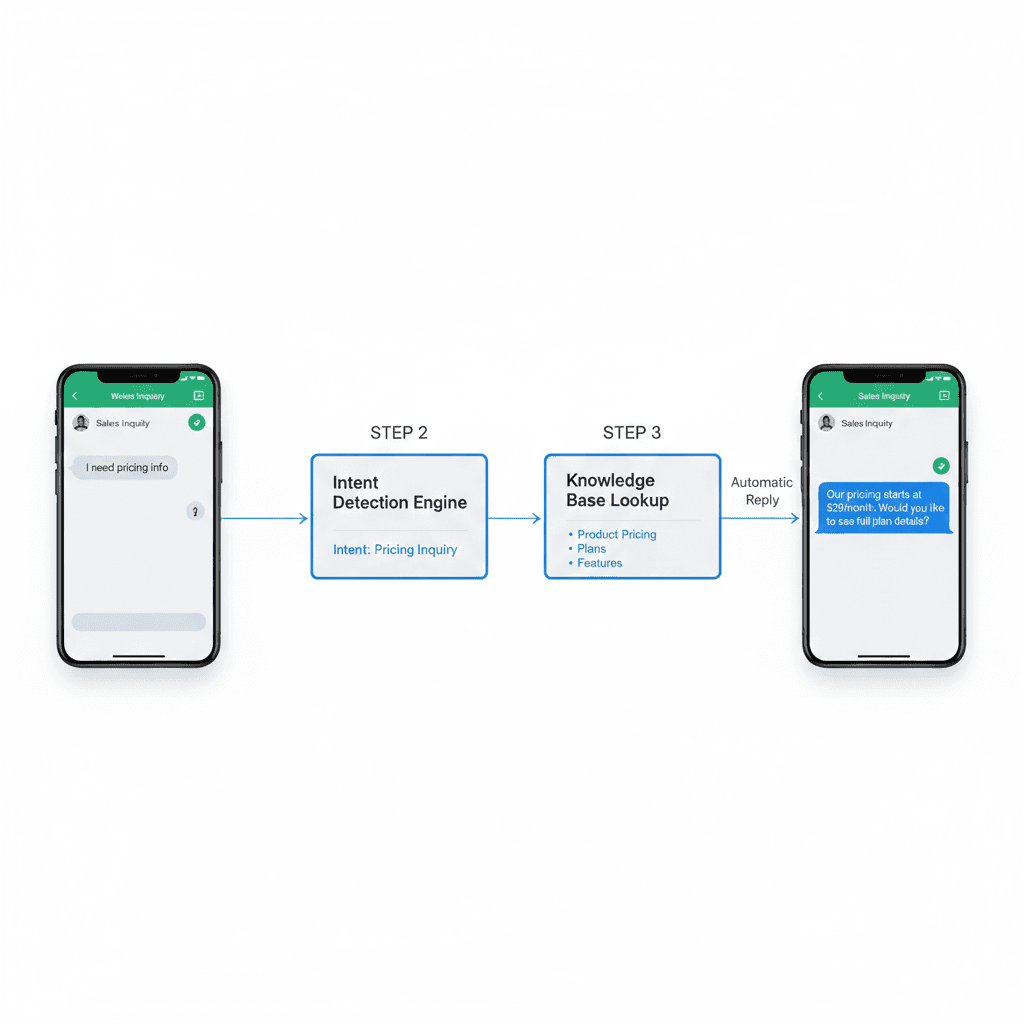
Consider a support example: a customer reports a bug via WhatsApp. The chatbot intake layer identifies the issue as "Technical Support," generates a ticket in the helpdesk software, and routes the conversation to the support team with the full conversation history attached. This immediate sorting fundamentally reduces unnecessary human workload and protects your operational bandwidth. Instead of paying an employee to manually read every message, determine its context, and assign it to the correct department, the business relies on the chatbot infrastructure to perform this administrative task in milliseconds.
How Automation Reduces Response Time and Improves Conversion
There is a direct mathematical correlation between response latency and sales conversion rates. When a business implements robust conversational automation, the immediate operational benefit is a drastic reduction in response time. Customers receive real-time replies the exact second they press send on WhatsApp. This immediate processing completely eliminates the traditional wait times associated with human-only queues and standard email ticketing systems.
This instant gratification is crucial during the lead capture phase. When a prospect engages with a business on WhatsApp, their purchase intent is typically at its absolute peak. Capturing that lead while intent is high requires immediate, friction-free interaction. If a prospect is forced to wait two hours for a manual reply, that initial buying intent dissipates rapidly. By automating the initial engagement and qualification process, the business secures the prospect's commitment quickly and drastically increases the overall conversion probability.
Furthermore, this immediate responsiveness translates into a fundamentally improved customer experience. Customers feel valued and understood when their inquiries are addressed without delay and without needing to navigate complex phone menus. Connecting automation to revenue outcomes is a straightforward exercise in speed-to-lead metrics. Faster response times lead to higher engagement rates, which inevitably push more qualified, highly educated leads through the sales pipeline and ultimately drive higher closed revenue figures.
Why Poorly Designed WhatsApp Chatbots Fail
While the theoretical benefits of automated conversation handling are clear, poor execution often leads to disastrous operational results. Many businesses deploy basic, rigid flows that trap users in endless numbered menus and fail entirely to understand nuanced, conversational questions. This lack of flexibility is a primary reason why website chatbots fail to deliver return on investment, and the exact same principles apply directly to WhatsApp infrastructure.
Poorly designed chatbots suffer from incorrect routing logic, sending frustrated customers to the wrong departments and exacerbating their irritation. Furthermore, a severe lack of clear escalation pathways prevents users from reaching a human agent when they have a highly complex problem that the automation simply cannot resolve. Implementing an inflexible system actively hurts customer experience by creating administrative friction rather than removing it, leading to increased customer churn.
Correct implementation requires a flexible, intent-driven architecture that prioritizes issue resolution and seamless human handoffs over simple keyword matching. It requires deep integration with your CRM and product databases to ensure the bot provides actual utility. Positioning Steps AI Chatbot as your core infrastructure provides the correct operational framework to avoid these common pitfalls. It delivers high-quality response generation, intelligent escalation protocols, and dynamic routing capabilities that function as a true, enterprise-grade infrastructure solution.
Conclusion
In the modern digital economy, WhatsApp chatbots are no longer optional messaging tools; they are essential conversational infrastructure for any business operating at scale. Manual inbox management is a fragile model that cannot survive the demands of high-volume traffic or the expectations of real-time customer engagement. To maintain operational efficiency, organizations must implement a robust conversational intake and routing layer that sits between the messaging platform and internal business systems. By converting unstructured WhatsApp messages into structured, actionable workflows, Steps AI Chatbot provides the necessary infrastructure to reduce response latency, automate routine replies, and ensure that every high-intent conversation reaches the correct team instantly. Adopting this systematic approach to WhatsApp communication is the only way to protect human capital while maximizing revenue potential in an increasingly conversational marketplace.
FAQs
How does a WhatsApp chatbot reply automatically?
A WhatsApp chatbot replies automatically by analyzing the incoming text using advanced natural language processing to determine the user's specific intent. Once the intent is identified securely, the chatbot queries its integrated knowledge base or connected business systems via API to generate a contextual, real-time response without any human intervention.
How do chatbots route conversations?
Chatbots route conversations by evaluating the categorized intent of a user's message against predefined business logic and routing rules. If a user asks a question about purchasing a product, the system triggers a workflow that assigns the conversation and all relevant chat history directly to the sales team's operational inbox.
Can WhatsApp chatbots replace human agents?
WhatsApp chatbots are not designed to fully replace human agents but rather to augment them by acting as a highly efficient first-line infrastructure layer. They successfully handle routine queries and simple administrative tasks, allowing human agents to focus exclusively on complex problem-solving and high-value strategic sales negotiations.
How do chatbots improve response time?
Chatbots improve response time by operating continuously on a server level and processing messages instantly the exact moment they are received. This immediate processing completely eliminates the wait times and backlog delays associated with human-only queues, ensuring customers receive accurate answers in milliseconds.
Are WhatsApp chatbots useful for sales?
Yes, WhatsApp chatbots are highly effective for modern sales operations because they can engage prospects immediately while their buying intent is at its peak. They automate the initial lead qualification process by asking essential scoping questions and securely capturing contact information before routing the highly qualified prospect to a human closer.
How does a WhatsApp chatbot connect to CRM or internal systems?
The chatbot connects to internal systems via API integrations and secure webhooks. When a conversation is processed, the chatbot intake layer transmits relevant data (such as user attributes or intent classification) to the CRM, helpdesk, or backend database. This ensures that the customer record is updated in real-time and that human agents have full context when a conversation is routed to them.