
Instagram direct messages have transitioned from a casual communication channel into a critical business interface. For modern businesses, SaaS providers, and ecommerce operators, Instagram DMs create immediate, real-time response expectations from customers and prospects. When businesses attempt to process this influx manually, it inevitably creates response latency. Operators find themselves constantly battling a growing queue, which leads to operational bottlenecks. Consequently, high-intent leads go cold due to slow replies, and the support load becomes unmanageable for internal teams.
Deploying an Instagram chatbot eliminates this operational friction by functioning as a conversational interface layer between your brand and your audience. Instead of relying on human operators to monitor and generate responses to every initial inquiry, the chatbot platform automatically handles message intake, intent classification, response generation, and routing. This guide explains how Instagram chatbot automated DMs function at an infrastructure level, including the system architecture, message processing pipeline, and implementation methodology required to deploy conversational automation effectively.
What an Instagram Chatbot Actually Does
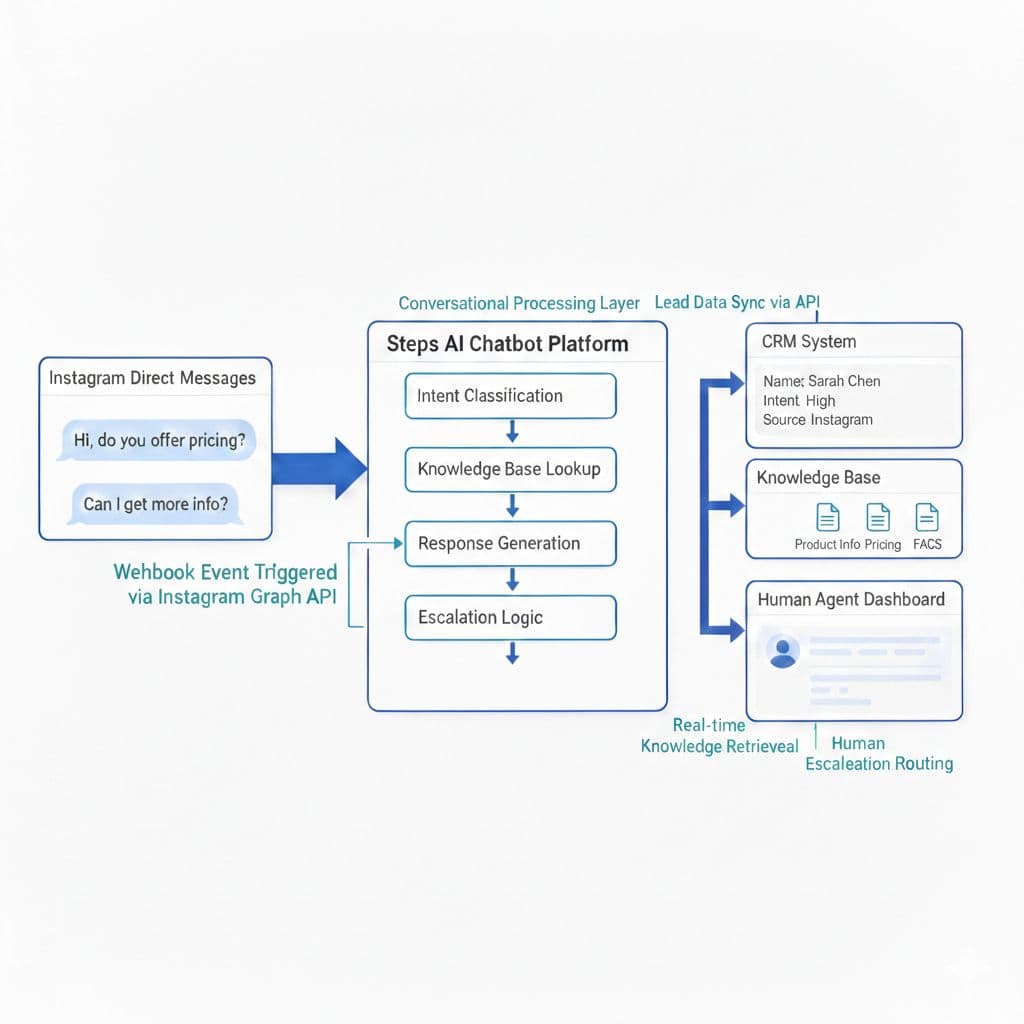
Understanding an Instagram chatbot requires looking past basic definitions and examining its core operational function. At an infrastructure level, an Instagram chatbot operates as a real-time message processing layer that continuously receives, evaluates, and responds to incoming conversations. Instagram sends incoming message events to the chatbot platform in real time via webhook notifications from the Instagram Graph API. Once a message is received, the chatbot platform does not generate a generic auto-reply. Instead, it processes the text through an intent classification system to analyze the user's underlying goal or requirement.
Upon determining the user's intent, the conversational system retrieves accurate answers directly from its knowledge base based on detected user intent. If the user is a prospective buyer, the system operates as a lead qualification chatbot, extracting structured lead data such as contact information, intent signals, and qualification criteria. Furthermore, when the system encounters a complex issue or a qualified prospect that requires human intervention, it routes the conversation securely to the appropriate internal team member.
In this capacity, an Instagram chatbot functions as your organization's first-response infrastructure. It is critical to differentiate between rigid automation, which relies on simple keyword triggers, and true conversational infrastructure, which understands context and executes dynamic dialogue. Implementing a sophisticated chatbot platform provides this necessary conversational layer, ensuring incoming messages are processed, classified, and routed to the correct system, team, or workflow automatically.
Core Infrastructure Required Before Setup
Deploying chatbot infrastructure requires establishing specific structural dependencies before any automation logic can be configured. The chatbot platform relies on a secure, authenticated pipeline to read and transmit messages on behalf of your brand.
Instagram Business Account
An Instagram Business Account is the foundational requirement for this infrastructure. Standard personal or creator accounts do not possess the necessary API access required for third-party chatbot infrastructure. Converting to a Business Account unlocks the Instagram Graph API, which is the protocol that enables external software to interact programmatically with your account's direct messaging inbox.
Meta Business Manager Connection
Your Instagram Business Account must integrate with a Meta Business Manager environment. This centralized hub processes the administrative authentication and messaging permissions required for the API pipeline. The Business Manager grants the specific access tokens that authorize your chosen chatbot platform to execute conversations. Without this API integration, the API will reject any attempts to read incoming webhooks or transmit outgoing payloads.
Chatbot Platform
A dedicated chatbot platform is required to serve as the operational brain of your deployment. An Instagram chatbot does not live natively "inside Instagram." Instead, it integrates with the platform via the API. You require a robust conversational system like Steps AI Chatbot to process incoming messages, configure the conversational workflows, integrate your company's knowledge base, and execute the routing protocols. Steps AI Chatbot integrates with Instagram via secure API integration and functions as the conversational layer that manages intent detection, response generation, and routing.
Step-by-Step: How to Set Up an Instagram Chatbot for Automated DMs
Implementing this automation infrastructure requires a methodical approach to infrastructure configuration, focusing on system behavior and operational logic.
Step 1: Connect Instagram to Chatbot Platform
The initial phase involves establishing the technical bridge between Instagram and your chatbot platform. This requires initiating an authentication sequence within the platform, which will redirect you to Meta to authorize the API integration. You must grant specific API permissions, notably the ability for the platform to process and access messages. Once authenticated, the chatbot platform establishes webhook subscriptions, enabling it to receive real-time data payloads whenever a user interacts with your direct messages.
Step 2: Configure Knowledge Base
The intelligence of your conversational system relies entirely on the data it can access. You must configure the knowledge base by uploading your operational documents, FAQs, product information, technical documentation, and service policies. Unlike keyword-based bots, the chatbot indexes this data into its knowledge base, enabling accurate, real-time responses during live conversations.
Step 3: Configure Intent Detection and Automation Logic
Once the data is accessible, you must define the rules of engagement. Configuring intent detection involves defining how the system identifies and classifies different types of inquiries. The chatbot platform distinguishes between routine support requests, actionable sales inquiries, and specific lead qualification signals. By configuring this intent classification system, you instruct the chatbot infrastructure on how to categorize a conversation the moment a message arrives.
Step 4: Configure Lead Capture and Qualification
For sales and marketing operations, the Instagram chatbot must function as a lead capture infrastructure. You configure conversational workflows that instruct the conversational system to systematically collect necessary data points such as the user's name, email address, and business type. As the chatbot platform interacts with the user, it extracts these variables and maps them to standard fields, automatically sending structured lead data to your CRM or internal sales systems in real time.
What Happens When a User Sends a DM
Understanding the exact sequence of events during a chatbot interaction provides clarity on the system's operational mechanics. The entire process functions as a rapid conversational processing pipeline.
User sends message →
Instagram triggers webhook event →
Chatbot platform receives message →
Intent classification →
Knowledge base lookup →
Response generation →
Chatbot platform sends reply via API →
Lead data stored if relevant →
Escalation triggered if required
Business Impact of Instagram DM Automation
Similar to a well-configured AI chatbot for websites, deploying an Instagram chatbot enables businesses to handle inbound conversations instantly and at scale. The immediate operational outcome is instant response capability for every incoming Instagram conversation. By eliminating manual queues, businesses reduce response latency from hours to milliseconds and prevent high-intent leads from disengaging.
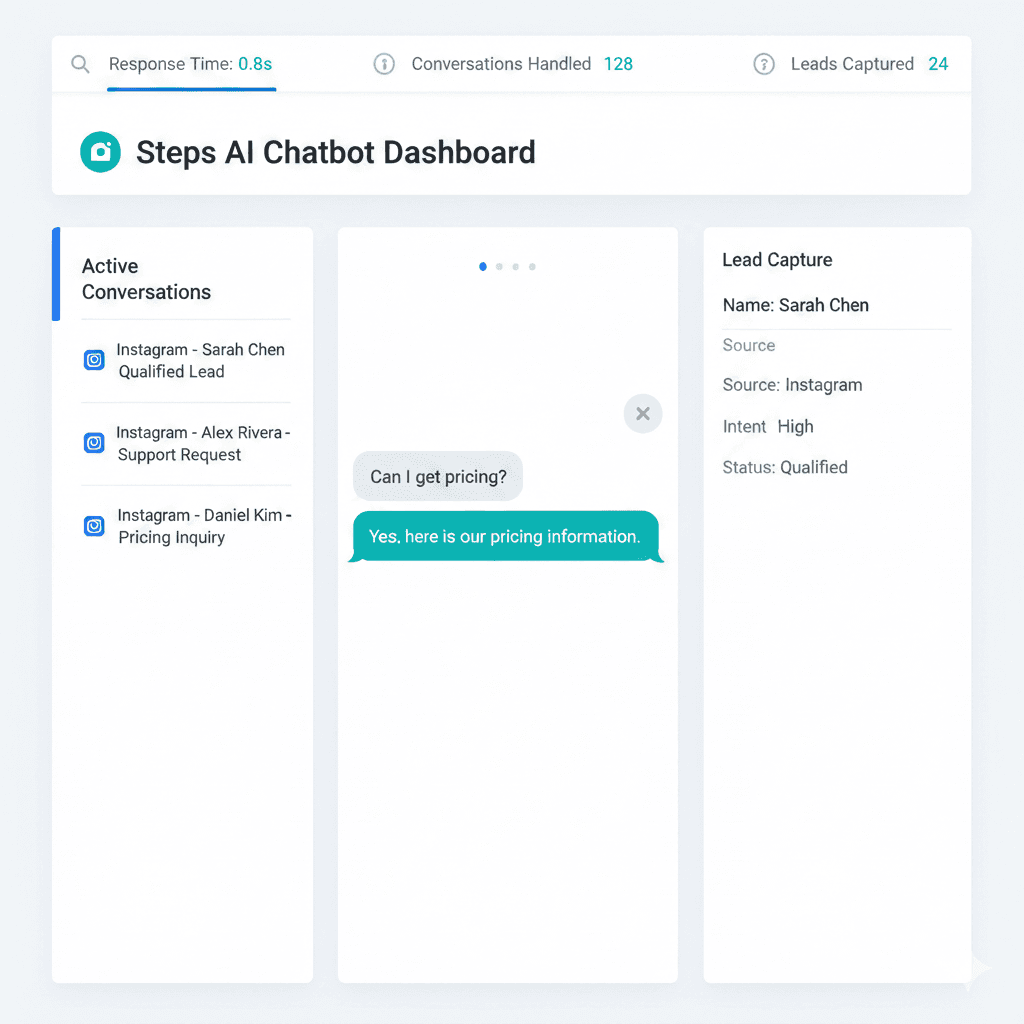
Simultaneously, the conversational system drastically reduces the baseline support load. By autonomously resolving tier-one inquiries, the chatbot infrastructure deflects a massive volume of tickets away from human agents. The ultimate operational advantage is the ability to maintain consistent response quality while achieving infrastructure scaling without additional headcount.
When Businesses Should Implement an Instagram Chatbot
Businesses should implement an Instagram chatbot when message volume exceeds the ability of human teams to respond instantly and consistently. This typically occurs when Instagram becomes a primary inbound channel for customer inquiries, product questions, or lead generation. Without automation infrastructure, response delays increase, lead capture becomes inconsistent, and support teams become operational bottlenecks.
Implementing a conversational system ensures that every incoming message is processed immediately, allowing businesses to capture leads, resolve inquiries, and maintain consistent response performance regardless of message volume.
Why Most Instagram Chatbot Implementations Fail
Despite the clear advantages, many businesses fail to achieve operational outcomes when deploying DM automation. The primary cause of failure is the reliance on legacy, keyword-based bots. These primitive systems execute rigid, pre-written text blocks and lack contextual understanding, causing the conversational processing pipeline to break down entirely.
Furthermore, failed implementations typically feature no intent detection capabilities and operate with an unoptimized knowledge base. When a system cannot accurately classify why a user is messaging, it creates a frustrating loop. Overcoming these failures requires abandoning basic auto-responders for true conversational infrastructure capable of dynamic reasoning and seamless human handoff.
How Steps AI Chatbot Enables Instagram Automation
Steps AI Chatbot integrates with Instagram via secure API integration and functions as the conversational layer that manages intent detection, response generation, and routing. The platform generates context-aware conversational responses rather than relying on rigid decision trees, allowing it to handle real customer inquiries accurately without human intervention.
The platform ensures accurate knowledge retrieval, anchoring its responses to the specific documentation in your knowledge base. Furthermore, the conversational system executes lead capture automation, allowing businesses to automatically qualify and capture leads during live Instagram conversations. Combined with granular escalation control and the ability to function alongside a website chatbot deployment, the platform enables scalable automation of Instagram conversations.
Conclusion
Instagram has solidified its position as a primary, real-time communication channel. Attempting to process this continuous influx of direct messages through manual handling does not scale. To operate efficiently, businesses must deploy chatbots to provide scalable conversational infrastructure that intercepts, processes, and resolves inquiries autonomously.
Steps AI Chatbot serves as the conversational infrastructure that enables automated DM handling, lead capture, and scalable customer communication. It provides the infrastructure required to automate Instagram conversations, capture leads in real time, and scale customer communication predictably without increasing support headcount.
FAQs
Can Instagram chatbots send automatic replies?
Yes, Instagram chatbots utilize the official Graph API to intercept incoming direct messages and instantly transmit automated text payloads back to the user based on configured automation logic and intent detection.
How do Instagram chatbots work technically?
Technically, they operate via webhook subscriptions. When a user transmits a DM, Meta’s servers transmit a data payload to the chatbot platform. The conversational processing pipeline processes the text, retrieves relevant data from an integrated knowledge base, and transmits an API request back to Instagram.
Do Instagram chatbots capture leads?
Yes, advanced conversational infrastructure is configured to identify sales intent and systematically extract specific variables during the dialogue, subsequently routing this structured lead capture data directly into an external CRM.
Can a chatbot escalate to human agents?
Yes, operational chatbot platforms feature routing protocols that monitor conversations for predefined escalation triggers, seamlessly executing a human handoff to a live operator when necessary.
Is Instagram chatbot setup difficult?
While basic automated replies are simple to configure, establishing true conversational infrastructure requires methodically configuring API permissions, indexing accurate knowledge base data, and designing clear intent classification systems.