
1. Why Shopify Stores Need a Chatbot in 2026
(More informative, more structured, more comparison-focused)
Shopify shoppers in 2026 expect real time support at every stage of the buying journey. They browse quickly, switch between multiple product tabs, and expect instant clarity on shipping, sizing, availability, and returns. When answers take too long, they abandon the store and search elsewhere.
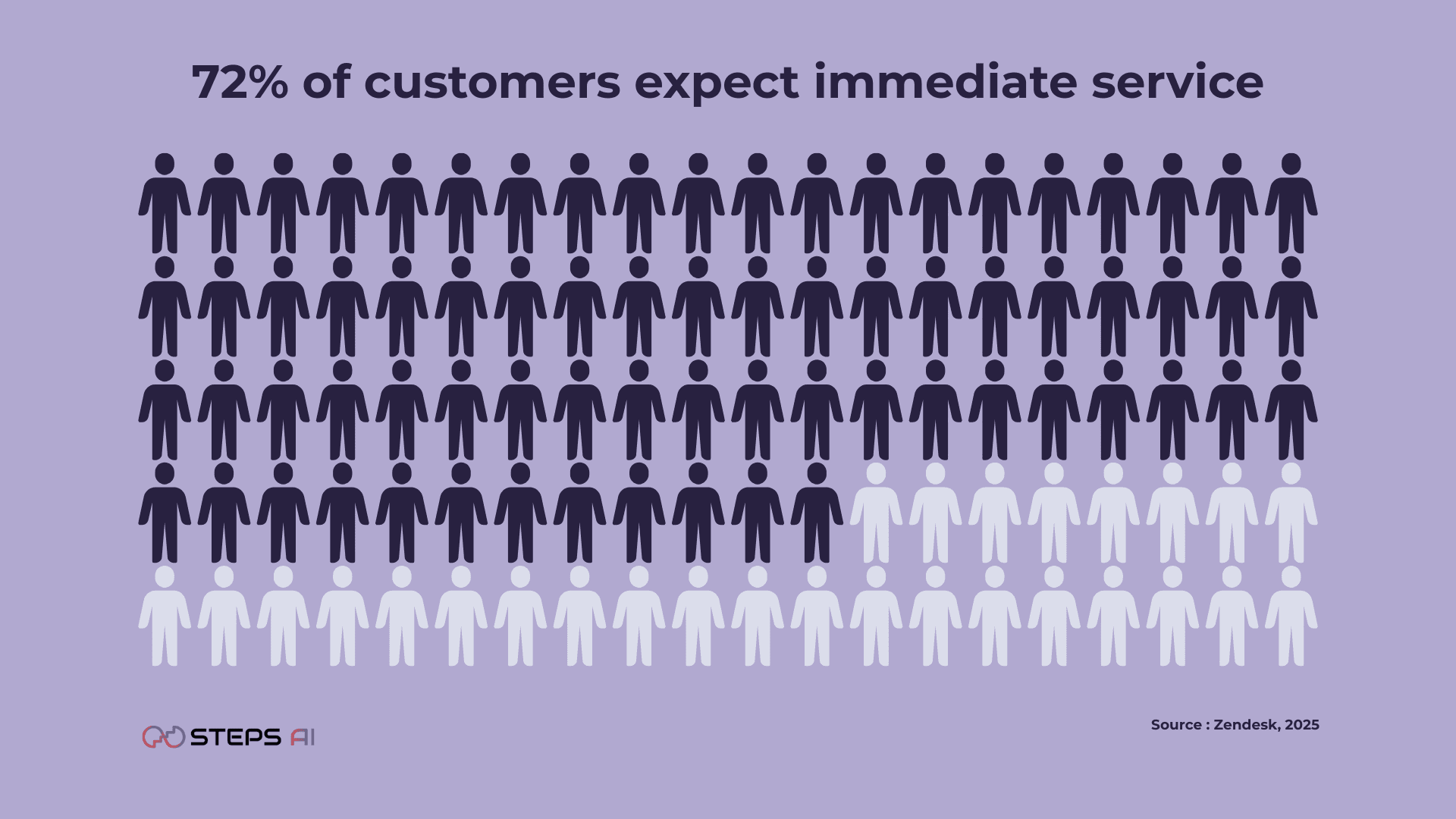
This is a measurable trend. According to Zendesk, 72 percent of customers expect immediate service. On Shopify, where purchase decisions often happen within seconds, this expectation directly impacts conversion rates and cart abandonment.
A Shopify chatbot addresses this need by giving instant, accurate responses without requiring a support agent. It reduces friction during product discovery, provides clarity during checkout, and handles post-purchase questions automatically. But the type of chatbot you choose matters. Flow-based bots can only answer simple, scripted questions, whereas reasoning-based chatbots adapt to complex queries and support real customer intent.
Important point: Shopify stores don’t just need a chatbot, they need the right chatbot that can handle the depth and speed customers expect in 2026.
2. The Three Types of Shopify Chatbots Explained
Not all Shopify chatbots offer the same level of intelligence or capability. Understanding the three main categories helps merchants choose a solution that matches their store’s complexity and growth goals. The differences between these chatbot types determine how well they handle product questions, automate support, and influence conversions.
1. Rule Based or Flow Based Chatbots
Examples: Tidio, Gorgias Chat
These chatbots use predefined responses, button-based flows, and keyword triggers. They work well for very simple FAQs such as “What are your store hours?” but fall apart when customers ask open-ended or layered questions like “Will this jacket fit me if I’m between sizes?” or “Is this laptop compatible with my monitor?”
They are easy to install and cheap but limited in accuracy. As a result, they often escalate most conversations to human agents, which increases support load instead of reducing it.
2. AI Assisted Chatbots
Examples: Shopify Inbox with AI, Intercom Fin
These bots can understand natural language better than rule-based tools. They pull data from help docs and FAQs and can generate conversational replies. However, they still depend heavily on manual setup and structured content. They can answer general questions but struggle with product-specific inquiries, inventory-based questions, or multi-step reasoning.
They are suitable for stores with moderate traffic but insufficient for merchants with large catalogs or complex policies.
3. Reasoning Based AI Chatbots
Example: Steps AI’s Chatbot
This is the newest and most advanced category. Unlike flow-based or AI-assisted bots, reasoning-based chatbots interpret intent, understand product context, handle unexpected questions, and complete real service actions. They ingest product descriptions, variants, materials, sizing rules, and store policies, allowing them to respond accurately even when customers ask nuanced or mixed questions.
These bots can track orders, check return eligibility, modify subscriptions, and give detailed product explanations without requiring human intervention.
Important point: only reasoning-based chatbots can match the complexity and expectations of modern Shopify customers, making them the most scalable option for 2026.
3. Shopify Chatbot Comparison: Key Factors That Actually Matter
With dozens of chatbot apps available for Shopify, the real challenge is understanding how they differ in capability and long-term value. The right chatbot can increase conversions and reduce support costs, while the wrong one can frustrate customers and burden your team.
Below are the core factors that determine how well each type of chatbot performs in real-world Shopify environments.
1. Accuracy and Depth of Responses
Accuracy is the biggest differentiator.
- Flow-based chatbots rely on prewritten answers which means they fail when customers ask anything outside the scripted paths.
- AI-assisted bots can understand natural language but still struggle with product-specific queries like sizing, materials, or compatibility.
- Reasoning-based chatbots (Steps AI) understand product attributes, variants, and policy details which allows them to answer complex questions with high accuracy.
Accurate answers reduce cart abandonment and improve customer trust, especially for higher-ticket or variant-heavy products.
2. Ability to Perform Real Actions
Most chatbots only provide informational responses. But modern customers expect more.
A strong Shopify chatbot should be able to:
- check order status
- start a return or exchange
- update subscriptions
- modify account details
- surface relevant recommendations
Flow-based bots do none of this. AI-assisted bots can partially automate it. Reasoning-based chatbots like Steps AI handle these fully, reducing support workload significantly.
3. Setup and Maintenance Requirements
Many Shopify chatbots require extensive flow-building and manual setup. This becomes more time-consuming as your catalog or policies change.
- Flow-based bots require constant updating.
- AI-assisted bots require structured content and knowledge base refinement.
- Reasoning AI tools like Steps AI learn directly from your Shopify catalog and policies with minimal setup and no flow management.
This makes them far more scalable for growing stores.
4. Support Automation Depth
Support automation is not only about answering questions but reducing total ticket volume.
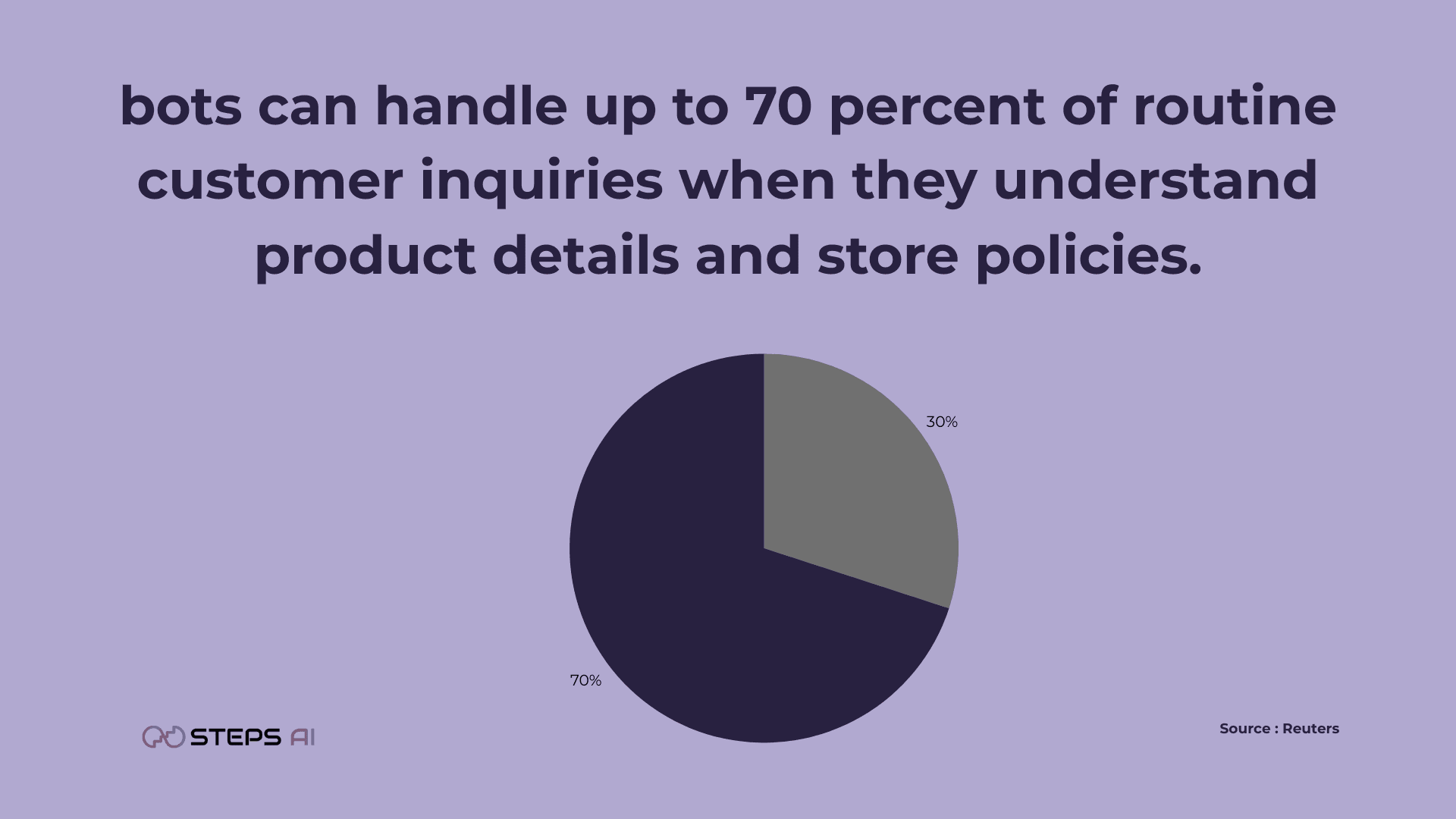
According to Reuters, bots can handle up to 70 percent of routine customer inquiries when they understand product details and store policies.
Flow-based bots never reach this level because they lack adaptability. AI-assisted bots get closer but still escalate many conversations. Reasoning bots can automate a much higher share of support interactions.
5. Impact on Conversions
Instant answers drive sales.
Zendesk reports that 51 percent of consumers prefer bots for immediate responses, which directly impacts checkout confidence.
When chatbots answer accurately, shoppers hesitate less and convert more. This makes reasoning-based chatbots the strongest option for stores where product clarity or sizing plays a major role in purchase decisions.
Important point: the quality of your chatbot directly affects your conversion rate, not just your support load.
4. Why Steps AI’s Chatbot Is Ideal for Shopify Stores
Most Shopify chatbots can respond to simple questions, but very few can understand customer intent, interpret complex product details, or take meaningful actions. Steps AI’s Chatbot does all three, which is why it stands out for Shopify merchants in 2026.
Steps AI learns directly from your Shopify catalog. It understands product descriptions, variants, materials, sizing guides, compatibility notes, and fulfillment details. This allows it to answer questions like:
- “Is this product compatible with my device?”
• “What size should I pick if I’m between measurements?”
• “How does this material compare to the other option?”
Instead of relying on rigid flows, it reasons through context which gives customers more accurate and helpful responses.
It also performs real service actions. Customers can track orders, check return eligibility, update subscription details, or modify account information inside the chat without waiting for a human agent. This reduces support tickets and helps shoppers resolve issues immediately.
Speed plays a major role in conversions. Research from Zendesk shows that 51 percent of consumers prefer bots for immediate answers, especially when they are close to making a purchase. Steps AI provides this instant clarity and prevents hesitation during checkout.

Another advantage is that Steps AI requires no flow building. Many Shopify chatbots need manual setup and constant maintenance. Steps AI adapts automatically as your products or policies change which makes it scalable for growing stores.
For a broader perspective on how chatbots shape ecommerce growth, you can explore Ecommerce Chatbots: Complete Guide.
Important point: Steps AI’s Chatbot combines deep product understanding, instant service actions, and conversion-focused intelligence, making it one of the strongest Shopify chatbot solutions for 2026.
5. How to Deploy a Shopify Chatbot Effectively
A Shopify chatbot performs well only when the information it relies on is complete, accurate, and easy for the AI to interpret. The quality of your product data, policies, and self-service resources directly affects how reliably the chatbot can support customers.
Start with your product information. Make sure descriptions, attributes, materials, sizes, variants, and compatibility notes are clear and structured. When a chatbot has access to clean product data, it can answer detailed questions confidently and guide shoppers toward the right purchase.
Your store policies matter just as much. Customers routinely ask about shipping timelines, return rules, warranties, and exchange steps. If this information is outdated or scattered, a chatbot will struggle to give accurate answers. Keeping these policies consistent ensures customers always receive reliable guidance.
Most Shopify stores still rely heavily on old-style FAQ pages, which customers rarely use effectively. According to Gartner, only 14 percent of customer issues are resolved through traditional self-service because the information is usually hard to navigate. A chatbot fills this gap by delivering the right answers instantly, but only if the underlying knowledge is well organized.

Important point: the more organized your product data and policies are, the more accurate and helpful your Shopify chatbot becomes which directly boosts conversions.
6. The Future of Shopify Automation in 2026
Shopify is shifting toward an automation-first customer experience. Shoppers no longer want to dig through FAQs or wait for email replies. They prefer real time conversations that help them make decisions quickly, which is why conversational AI is becoming a core part of how ecommerce stores operate.
AI adoption is accelerating fast. According to Salesforce, AI will resolve 50 percent of customer service cases by 2027. This signals a major industry shift where automated support becomes a standard expectation rather than a competitive advantage.
For Shopify merchants, this automation trend affects several areas:
- Product discovery becomes conversational instead of search-based
• Checkout decisions become faster when chatbots remove uncertainty
• Post purchase support becomes instant and self directed
• Support teams operate with fewer repetitive inquiries
• Store operations scale without additional staffing
As conversational AI becomes more capable, Shopify stores with clean product data, structured policies, and a reliable chatbot will outperform those relying on traditional support workflows.
Steps AI’s Chatbot is designed for this future. It understands product context, reasons through customer intent, and automates complex support actions, making it a scalable solution for growing ecommerce brands.
Important point: automation is becoming a foundational part of the Shopify ecosystem, and merchants who adapt early will gain a long-lasting advantage in customer satisfaction and operational efficiency.
Final Note
Shopify stores in 2026 operate in an environment where speed, accuracy, and seamless support define customer loyalty. A modern chatbot is no longer just a support tool. It influences conversions, reduces operational workload, and shapes the overall shopping experience.
Steps AI’s Chatbot is built for merchants who want more than scripted replies. It understands products deeply, performs real customer service actions, and delivers instant answers that help shoppers move confidently toward purchase. This combination makes it a powerful upgrade for stores looking to grow efficiently and improve customer satisfaction.
If your goal is to streamline support, increase conversions, and prepare your store for the next era of Shopify automation, a reasoning-based chatbot is the strongest investment you can make.
Explore Shopify chatbot automation at Steps AI and see how it can transform your support experience and drive measurable growth.
FAQs
1. What is a Shopify chatbot?
A Shopify chatbot is an AI tool that helps customers with real time support inside your Shopify store. It can answer product questions, explain policies, guide purchases, and even automate tasks like order tracking or return checks. The best Shopify chatbots understand product context and customer intent rather than relying on scripted responses.
2. Which type of Shopify chatbot is best for ecommerce stores?
Reasoning-based chatbots are the strongest option for 2026. Unlike flow-based or AI-assisted bots, they can interpret complex questions, understand product details, and complete real support actions. This leads to higher customer satisfaction and fewer support escalations.
3. How does a Shopify chatbot improve conversion rates?
Chatbots reduce hesitation by giving shoppers instant clarity on shipping, returns, sizing, materials, and compatibility. Since 51 percent of consumers prefer bots for immediate answers (Zendesk), providing instant support directly increases checkout completion and lowers cart abandonment.
4. Can a Shopify chatbot replace human support teams?
A chatbot cannot replace human agents, but it can significantly reduce their workload. It handles the bulk of repetitive questions so your support team can focus on complex issues. This improves response times and reduces support costs without sacrificing service quality.
5. Why choose Steps AI’s Chatbot for Shopify?
Steps AI’s Chatbot uses reasoning to understand product context, perform real actions such as returns or tracking updates, and deliver accurate answers without flow building. It is designed for Shopify scalability, making it ideal for brands that want faster support, higher conversions, and automated operations.