Your customer experience directly impacts whether people buy once or become repeat customers. One frustrating support interaction can send someone to a competitor. One delayed response can cost you a sale. One unanswered question can mean they never come back.
The relationship between customer service and retention is clear: better service keeps customers longer. What's changed is how businesses deliver that service. A well-implemented customer service chatbot doesn't just answer questions. It fundamentally improves the customer experience in ways that drive loyalty and increase retention. Platforms like Steps AI are designed specifically to enhance customer experience through instant, helpful interactions that keep people coming back.
This guide explores exactly how customer service chatbots improve both experience and retention, backed by specific mechanisms and real impact data.
Instant Gratification: The Speed Factor
The single biggest way a customer service chatbot improves experience is speed. Customers want answers now, not in four hours, not tomorrow, right now.
Traditional customer service means waiting. You submit a ticket, you get an automated "we received your inquiry" email, and then you wait. Maybe two hours, maybe six, maybe until the next business day. During that waiting period, you're stuck. You can't move forward with your purchase, you can't solve your problem, you're in limbo.
A customer service chatbot eliminates waiting for routine questions. "What's your return policy?" Answered in 10 seconds. "Do you ship to Canada?" Instant response. "How do I reset my password?" Solved immediately.
This speed creates a fundamentally better experience. Customers get unstuck and move forward. They don't lose momentum. They don't forget why they were interested in the first place. They stay engaged with your business instead of drifting to competitors.
The retention impact: When customers consistently get fast help, they associate your brand with efficiency and respect for their time. This positive association drives repeat business. Studies show that customers who get instant support are 3x more likely to make repeat purchases compared to those who experience delays.
24/7 Availability: Meeting Customers When They Need Help
Customer questions don't follow business hours. Someone researching products at 11 PM has the same need for answers as someone browsing at 11 AM. But traditionally, only the daytime customer gets help.
A customer service chatbot provides consistent support regardless of when customers reach out. The person shopping at midnight gets the same instant help as the person shopping at noon. Weekend shoppers get answers. Holiday browsers get assistance. International customers in different time zones get support during their daytime, even if it's your nighttime.
Why this matters for experience: Customers don't feel abandoned. They don't hit a wall where they can't get help and have to wait. The experience feels complete and supported at any hour.
Why this matters for retention: When customers know they can always get help from your business, trust builds. They're more likely to return because they've experienced reliable support. Conversely, businesses that only offer time-limited support train customers to look elsewhere when they need help outside those hours.
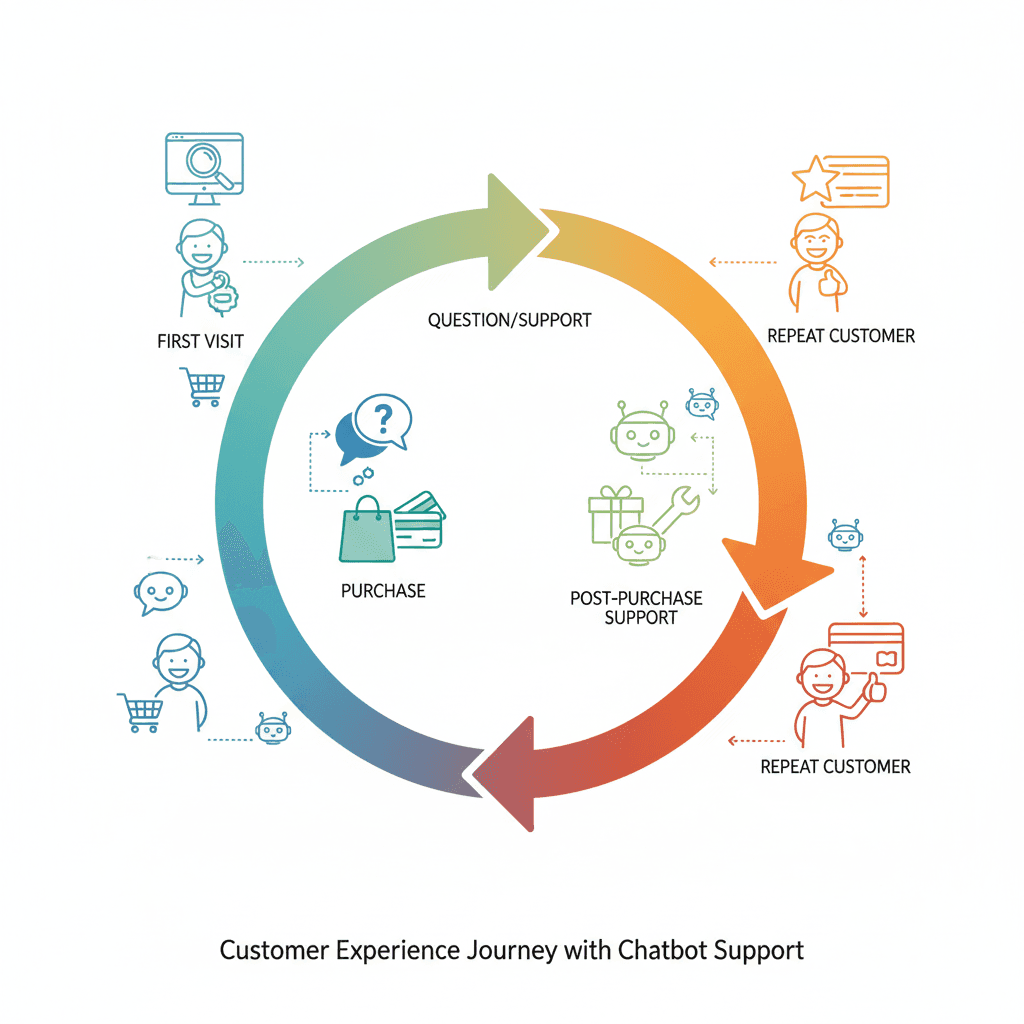
Understanding customer service chatbot use cases across the customer journey shows how 24/7 support impacts different touchpoints from initial research through post-purchase support.
Consistency: Every Customer Gets the Same Quality Answer
Human support teams, despite their best efforts, sometimes provide inconsistent information. One agent interprets a policy one way, another agent interprets it slightly differently. Someone new gives incomplete information. Someone having a rough day provides curt responses.
A customer service chatbot delivers perfectly consistent answers every single time. The 500th person who asks about your return policy gets the exact same accurate information as the first person. There's no variation based on who answered, when they answered, or what kind of day they're having.
The experience improvement: Customers can trust the information they receive. They're not wondering if they should ask again to verify, or if a different agent might give a different answer. This reliability creates confidence.
The retention impact: Consistency builds trust over time. When customers repeatedly get accurate, helpful information from your chatbot, they trust your business more broadly. Trust is one of the strongest drivers of customer retention.
Reduced Friction: Removing Obstacles From the Customer Journey
Every unanswered question is friction. Every moment of uncertainty is a potential exit point. A customer service chatbot identifies and removes these friction points in real-time.
Someone's about to purchase but isn't sure about sizing. The chatbot provides sizing guidance immediately. Someone's comparing your product to a competitor's but can't find a specific feature detail. The chatbot surfaces that information instantly. Someone's ready to buy but has a question about your warranty. The chatbot explains the policy on the spot.
Without a chatbot, these friction points cause abandonment. Customers leave to "think about it" or "do more research" and never return. With a chatbot, friction gets resolved immediately, and the customer moves forward.
The experience improvement: Customers accomplish what they came to do without hitting roadblocks. Their interaction with your business feels smooth and frictionless.
The retention impact: When customers have smooth experiences, they're more likely to choose you again. They remember that buying from you was easy, while buying from competitors felt complicated or frustrating.
Proactive Support: Addressing Issues Before They Escalate
The best customer service prevents problems rather than just solving them. A customer service chatbot can provide proactive support at critical moments.
When someone's been on a checkout page for two minutes without completing a purchase, the chatbot can offer help: "Need assistance completing your order? I can help with any questions." When someone's viewing a complex product, the chatbot can proactively offer information: "This product works with both Mac and Windows. Have questions about compatibility?"
This proactive approach catches confusion or uncertainty before it turns into abandonment. Customers get help before they even realize they need to ask for it.
The experience improvement: Customers feel guided and supported rather than left to figure everything out themselves. It creates a sense of being taken care of.
The retention impact: Proactive support creates memorable positive experiences. Customers remember businesses that anticipated their needs and helped before being asked. This differentiates you from competitors who only react to explicit requests.
Reduced Frustration: Escalation That Works
Here's where many chatbots fail, but good ones excel: knowing when to hand off to humans. A customer service chatbot that recognizes its limits and smoothly escalates to human support creates a better experience than one that keeps trying to help when it can't.
When a customer has a complex issue, the chatbot should acknowledge it: "This needs investigation. Let me connect you with our team." When someone's frustrated, the chatbot should detect it and escalate. When multiple attempts haven't resolved the issue, handoff should happen automatically.
The experience improvement: Customers don't feel trapped talking to a bot that can't help them. They get to humans when humans are needed, but only then. This combination of automated efficiency and human expertise when necessary creates the best overall experience.
The retention impact: Customers who experience smooth problem resolution, whether with chatbot or human, are more likely to stay customers. It's not about never having issues. It's about resolving issues well when they occur.
Data-Driven Personalization Over Time
An often-overlooked benefit of customer service chatbots is their ability to improve individual customer experiences over time through data.
The chatbot can recognize returning customers and reference their history. "Welcome back! How's that jacket you ordered last week working out?" It can remember preferences and past issues. It can provide increasingly personalized support as it accumulates interaction data.
The experience improvement: Customers feel recognized and valued rather than treated as anonymous transactions. Personalized support creates emotional connection.
The retention impact: Personalization is a proven retention driver. When customers feel like you know them and remember them, they're significantly more likely to remain loyal.
The Compound Effect: Small Improvements, Big Retention Impact
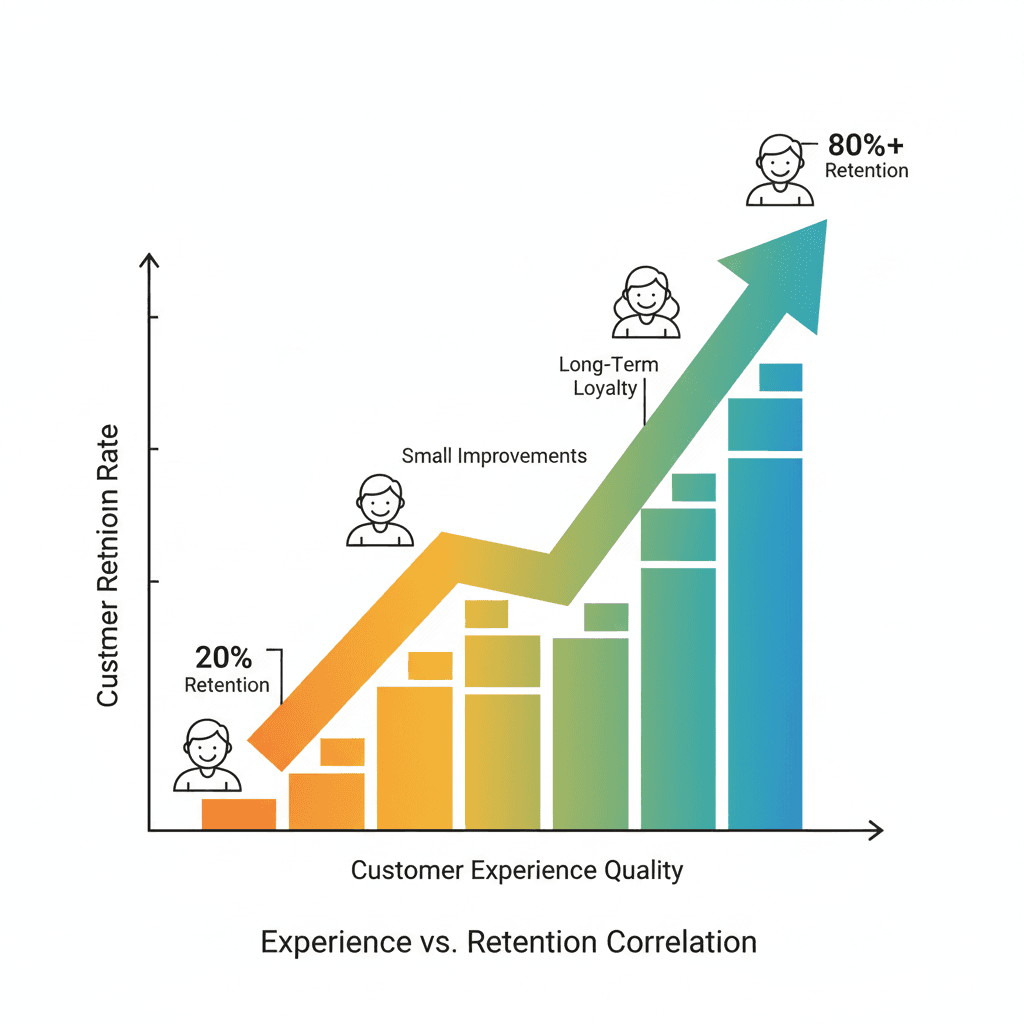
Each individual improvement a customer service chatbot creates might seem modest. Faster responses save a few minutes. 24/7 availability helps some percentage of customers. Consistency prevents some confusion.
But these improvements compound. A customer who experiences fast help, gets support outside business hours, receives consistent information, encounters no friction, gets proactive assistance, and feels recognized isn't just slightly more satisfied. They're dramatically more likely to become a loyal, retained customer.
The businesses seeing the biggest retention improvements from chatbots aren't doing one thing exceptionally well. They're doing many things consistently well, and the cumulative effect transforms the overall customer experience.
Recognize the signs your website is ready for an AI chatbot to determine if your business would benefit from these retention-driving experience improvements.
Ready to improve retention through better experiences? Try Steps AI free and see how a well-implemented customer service chatbot transforms customer satisfaction and loyalty.
The Bottom Line
Customer experience and retention are inseparable. Every interaction shapes whether customers stay or leave. A customer service chatbot improves experience through speed, availability, consistency, friction reduction, proactive support, smart escalation, and personalization.
These improvements aren't theoretical. Businesses implementing effective customer service chatbots see measurable retention increases. Customers stick around longer, buy more frequently, and recommend the business to others more often.
The key is implementation quality. A poorly designed chatbot can hurt experience and retention. But a well-designed one, providing genuine value and smooth human handoff when needed, becomes a competitive advantage in customer retention.
Frequently Asked Questions (FAQs)
How much can a chatbot improve customer retention rates?
Businesses with effective customer service chatbots typically see retention rate improvements of 5-15% within the first year. The exact impact depends on your baseline retention, industry, and chatbot implementation quality.
Do customers prefer chatbots or human support?
For simple, routine questions, most customers prefer chatbots because they're faster. For complex or emotional issues, customers prefer humans. The best experience offers both: chatbot for speed on simple questions, smooth escalation to humans when needed.
Can a chatbot hurt customer experience?
Yes, if poorly implemented. Chatbots that can't answer common questions, provide wrong information, make escalation difficult, or appear at annoying times damage experience and retention. Quality matters enormously.
How do you measure chatbot impact on retention?
Track repeat purchase rate, customer lifetime value, churn rate, and Net Promoter Score before and after chatbot implementation. Compare customers who interact with your chatbot versus those who don't to isolate the impact.
What makes a customer service chatbot good for retention?
Accuracy (correct information), speed (instant responses), availability (24/7), escalation (smooth handoff to humans), and personalization (remembering customer context). Chatbots strong in these areas drive retention. Weak ones don't.