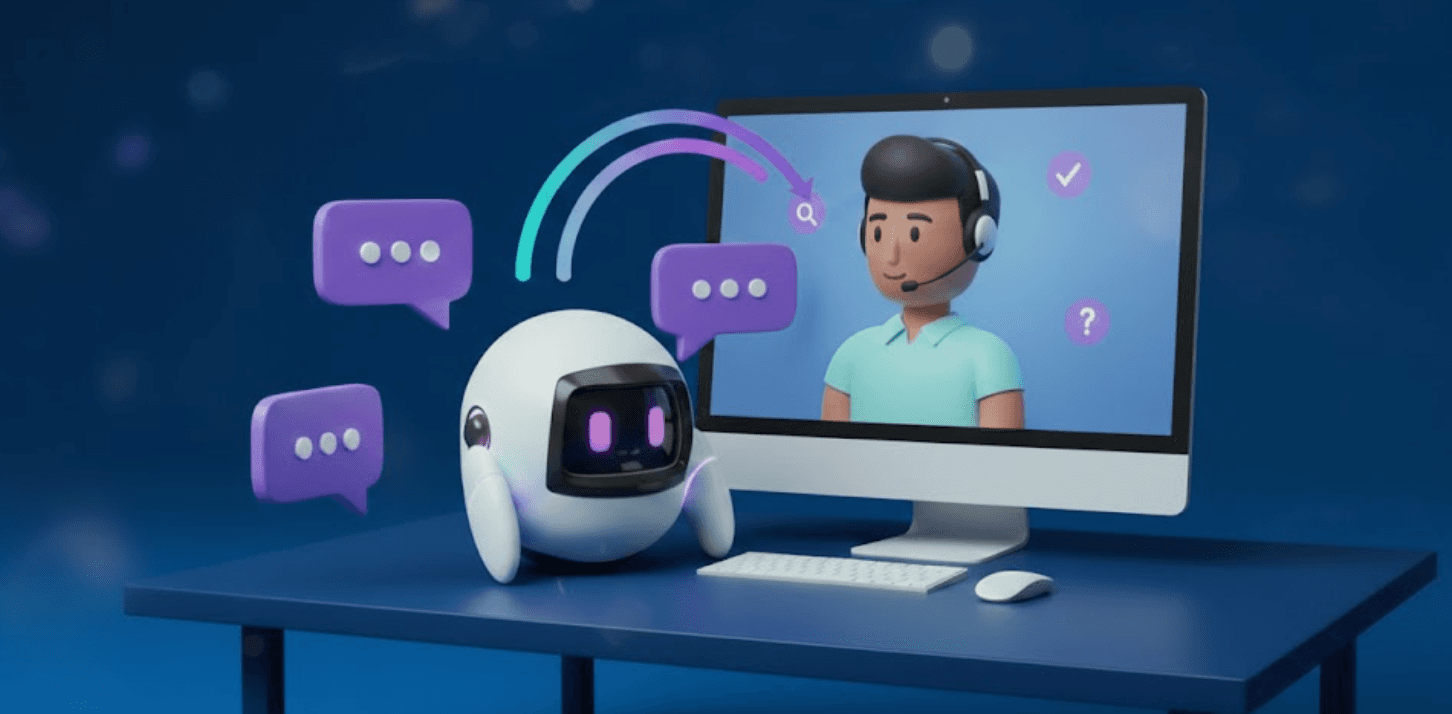
There's a common misconception about customer support chatbots: that they're meant to replace human agents entirely. Business owners worry about losing the personal touch. Support teams fear being replaced by automation. Customers worry about getting stuck talking to a bot that can't actually help them.
The reality is completely different. An effective customer support chatbot doesn't replace human agents. It works alongside them, handling the routine questions that consume most support capacity while ensuring humans focus on what they do best: complex problem-solving, relationship building, and situations requiring empathy and judgment. Platforms like Steps AI are specifically designed for this human-AI collaboration, making the handoff seamless and the combined experience better than either could provide alone.
This guide explores how customer support chatbots and human agents actually work together in practice, and why this collaboration delivers better results than either approach alone.
The Division of Labor: What Bots Handle, What Humans Handle
The most effective support operations use a clear division of labor between chatbots and humans based on what each does best.
What customer support chatbots handle:
Routine informational questions with straightforward answers. "What are your business hours?" "Where's my order?" "How do I reset my password?" These questions don't require judgment or empathy. They just need accurate information delivered quickly.
Policy clarification and documentation access. "What's your return policy?" "How do I export data?" The answers exist in your documentation. The chatbot makes them instantly accessible.
First-level troubleshooting. "The app isn't loading" can often be solved with "clear your cache and refresh." The chatbot walks customers through common fixes before involving humans.
Account management tasks. Password resets, email updates, billing information access. These are self-service actions that don't need human intervention.
What human agents handle:
Complex issues requiring investigation. "I was charged twice but only received one item" needs someone to dig into order history, payment records, and shipping logs.
Emotionally charged situations. Upset customers, complaints, refund disputes. These situations need empathy, flexibility, and relationship management that AI can't provide.
Nuanced decision-making. "Can you make an exception to your return policy because..." requires judgment calls that consider context, customer history, and business priorities.
Unique or unprecedented situations. Problems that don't fit documented patterns need human creativity and problem-solving.
Understanding customer support chatbot use cases helps identify which questions should be automated versus which genuinely need human expertise.
The Handoff: How Chatbots Transfer to Humans
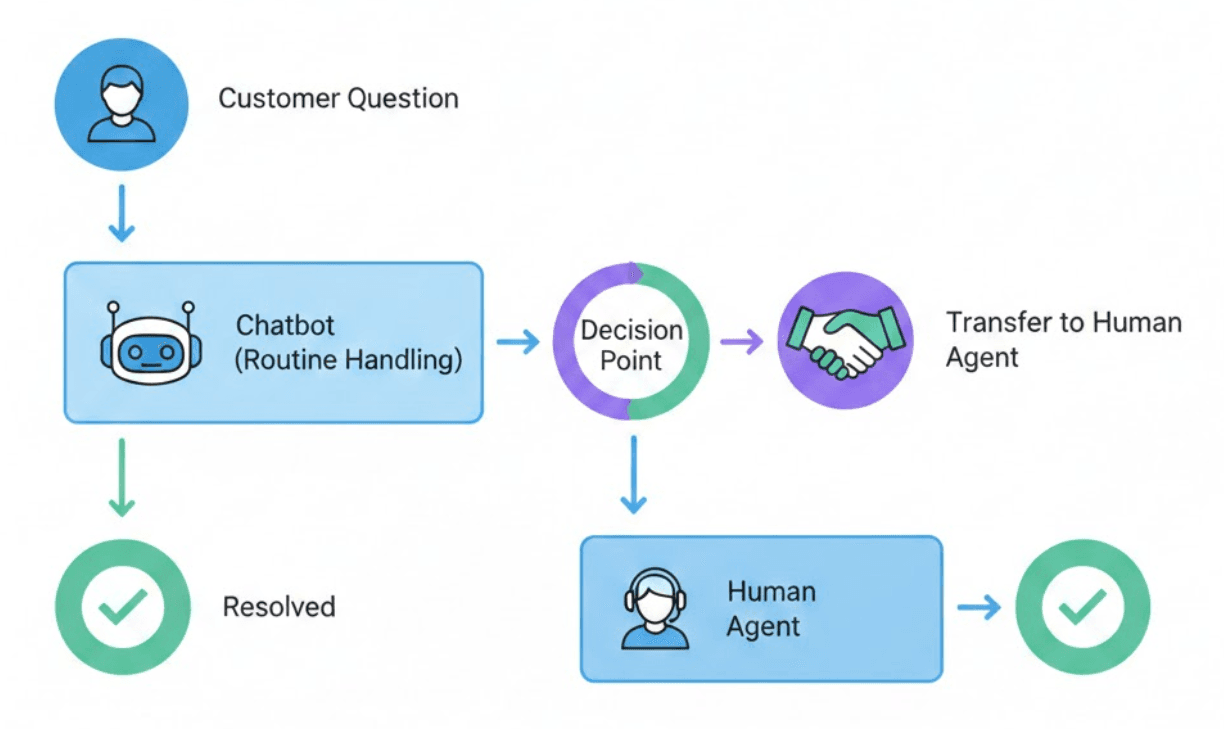
The most critical moment in chatbot-human collaboration is the handoff. A smooth handoff maintains customer satisfaction. A clunky one creates frustration.
When handoff happens:
The chatbot recognizes it can't help. "I don't have information about that specific issue. Let me connect you with our team who can help."
The customer explicitly asks for a human. "Can I speak to a person?" should immediately trigger handoff, not defensive bot responses.
The issue is complex or sensitive. The chatbot detects keywords indicating frustration, anger, or complexity beyond its scope.
Multiple attempts haven't resolved the issue. If the customer rephrases the same question three times, it's time for human intervention.
What makes a good handoff:
Context preservation. The human agent sees the entire chatbot conversation. The customer doesn't have to repeat themselves or start over. "I see you were asking about order #12345. Let me look into that charge issue for you."
Clear communication. The customer knows they're being transferred and why. "This needs some investigation. I'm connecting you with Sarah from our billing team who can sort this out."
Quick connection. The handoff happens immediately or provides a clear timeline. "Connecting you now" or "Our team will respond within 2 hours."
Appropriate routing. The chatbot identifies the issue type and routes to the right department or specialist, not just a general queue.
Real-Time Collaboration: Chatbots Assisting Human Agents
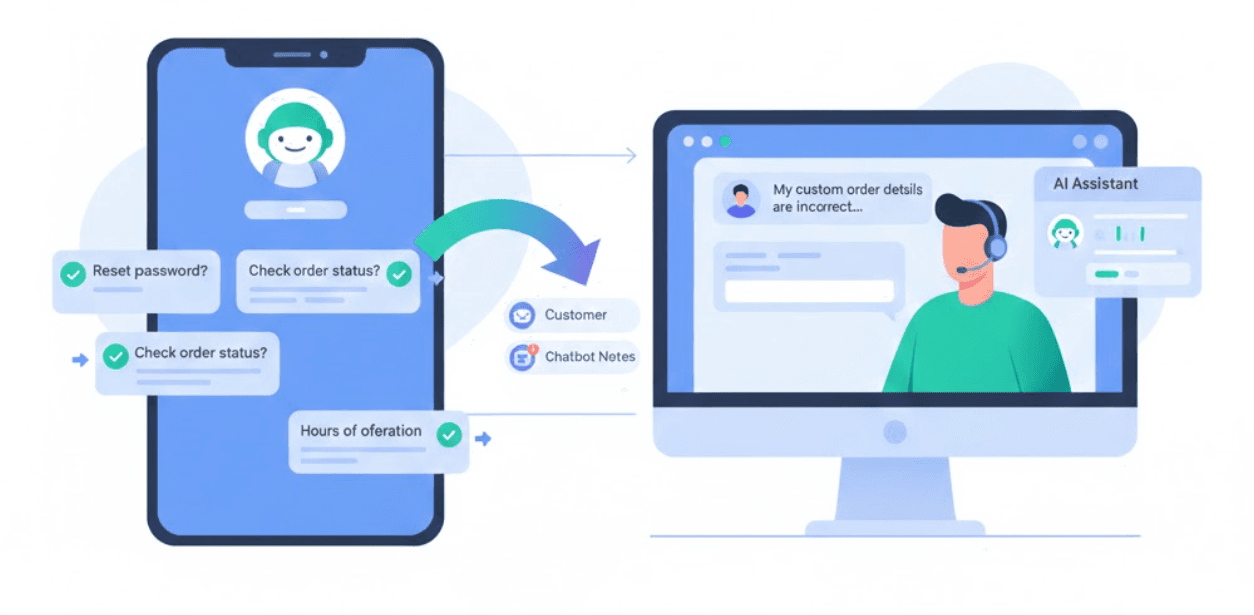
The collaboration doesn't end at handoff. Modern customer support chatbots actively assist human agents during conversations.
Suggested responses: As the agent converses with a customer, the chatbot analyzes the conversation and suggests relevant responses, knowledge base articles, or policy information. The agent can use these suggestions as-is or customize them.
Information lookup: The agent asks the chatbot to pull customer history, order details, or account information without leaving the conversation. "Show me this customer's last 3 orders" happens in seconds.
Policy reference: When a customer asks about a policy, the chatbot surfaces the relevant section for the agent to reference or quote. The agent doesn't need to search through documentation manually.
Language translation: For international support, the chatbot can assist with translation, helping agents communicate with customers in different languages.
This real-time assistance makes human agents more efficient and more accurate. They spend less time searching for information and more time actually helping customers.
Quality Control: Chatbots Learning From Human Interactions
The collaboration flows both ways. Human agents make chatbots better over time.
Identifying gaps: When multiple customers ask questions the chatbot can't answer, that signals a knowledge gap. Support teams flag these conversations, and the missing information gets added to the chatbot's knowledge base.
Refining responses: Agents see which chatbot responses lead to confusion or follow-up questions. This feedback helps improve how the chatbot explains things.
Updating for changes: When products, policies, or procedures change, human agents ensure the chatbot gets updated with current information. They're the first to know what's changed and can update the chatbot accordingly.
Training on edge cases: Unusual situations handled by humans become learning opportunities. "Next time someone asks about X, here's how to handle it." The chatbot expands its capabilities based on real support scenarios.
The Customer Experience: Seamless Support Regardless of Who Helps
From the customer's perspective, the customer support chatbot and human agents should feel like one integrated support system, not two separate entities.
Consistent information: Whether talking to the chatbot or a human, customers get the same accurate information about policies, procedures, and products.
Conversation continuity: If a customer starts with the chatbot and escalates to a human, the human has full context. The customer never has to say "as I already explained..."
Appropriate escalation: Customers aren't forced to struggle with a chatbot that can't help them. The bot recognizes its limits and connects them to humans when needed.
24/7 availability with human backup: The chatbot handles off-hours support for routine questions. For complex issues, it collects information and creates a ticket for the human team to address during business hours.
See ecommerce website chatbot examples for specific scenarios showing how this collaboration works in practice.
The Team Impact: How This Changes Support Operations
For support teams, chatbot-human collaboration fundamentally changes daily work.
Higher job satisfaction: Agents spend their time on interesting, complex problems that use their skills and expertise. They're not burning out answering "what's your return policy" for the hundredth time this week.
Better performance metrics: When chatbots handle routine volume, agents have more time per conversation. This leads to better resolution rates, higher customer satisfaction scores, and more thorough problem-solving.
Reduced burnout: The endless stream of repetitive questions is exhausting. When chatbots absorb that volume, agents face more manageable workloads and varied, engaging work.
Skill development: Agents focus on complex scenarios that develop their problem-solving, empathy, and decision-making skills rather than memorizing FAQs.
Scalability: As the business grows, the chatbot handles most of the volume increase. You don't need to hire support agents at the same rate as customer growth.
Implementation: Setting Up Effective Collaboration
Making chatbot-human collaboration work requires intentional setup, not just installing a chatbot and hoping for the best.
Define clear boundaries: Document which types of questions the chatbot should handle versus when it should escalate. Train your team on these boundaries so everyone understands the division of labor.
Set up seamless handoff: Choose a customer support chatbot platform that integrates with your support tools (help desk, CRM, ticketing system). The handoff should happen within the same conversation thread.
Establish feedback loops: Create a process for agents to flag chatbot issues, suggest improvements, and update information. Regular reviews ensure the chatbot keeps getting better.
Train your team: Help agents understand how to work with the chatbot effectively. They should know how to check chatbot conversations, override responses when needed, and use chatbot-suggested information.
Monitor the collaboration: Track metrics like handoff volume, agent response time, customer satisfaction for bot vs. human conversations, and overall ticket deflection. Use this data to optimize the division of labor.
Ready to implement collaborative support? Try Steps AI free and see how seamlessly chatbots and human agents can work together.
The Bottom Line
The question isn't "chatbot or human agents?" It's "how do we use both to deliver the best possible support?"
A well-implemented customer support chatbot handles the high-volume, routine questions that consume most support capacity. Human agents focus on complex, nuanced, and emotionally sensitive situations that benefit from human judgment and empathy. The handoff between them is smooth, preserving context and customer satisfaction.
This collaboration delivers better results than either could achieve alone. Customers get faster responses for simple questions and thoughtful, thorough help for complex issues. Support teams handle higher volumes with less burnout. Businesses scale support more efficiently.
The businesses seeing the best results don't view chatbots as agent replacement. They view them as agent augmentation, making their human team more effective, more satisfied, and more focused on work that truly requires human expertise.
Frequently Asked Questions (FAQs)
Will a chatbot replace human support agents?
No. A customer support chatbot handles routine, repetitive questions, but complex issues, emotional situations, and nuanced decisions still need human agents. Most businesses maintain or even grow their human support teams because chatbots help them scale, not replace people.
How do customers feel about being transferred from bot to human?
When done well, customers appreciate it. They get instant help for simple questions from the chatbot, and smooth escalation to humans when needed. Poor handoffs that make customers repeat information create frustration, which is why context preservation is critical.
What percentage of conversations need human escalation?
This varies by business, but typically 30-50% of chatbot conversations eventually escalate to humans. The chatbot handles simple questions completely, while more complex inquiries get transferred after initial information gathering.
Can human agents override chatbot responses?
Yes. Agents should have the ability to step in and correct chatbot information if needed, customize responses for specific situations, and make judgment calls that differ from standard chatbot answers when circumstances warrant it.
How do you measure the success of chatbot-human collaboration?
Track ticket deflection rate (how many issues the chatbot resolves), average handling time for agents (should decrease as chatbots handle routine questions), customer satisfaction for both bot and human interactions, and agent satisfaction scores. Successful collaboration improves all these metrics.